

If you live with interstitial cystitis or bladder pain syndrome (IC/BPS), it can be easy to assume that every sensation of urgency, pressure, or pain is coming solely from the bladder.
But the bladder doesn’t function in isolation.
The pelvic organs, pelvic floor muscles, and nervous system are closely connected. And when bladder symptoms persist, understanding those relationships can give us a much more complete picture of what may be contributing to the symptoms you feel.
The Bladder and Pelvic Floor Are Designed to Work Together
Your pelvic floor is a group of muscles at the base of the pelvis. Among its many jobs, it helps support the pelvic organs and participates in bladder and bowel function.
For urination to happen efficiently, the bladder and pelvic floor have to coordinate.
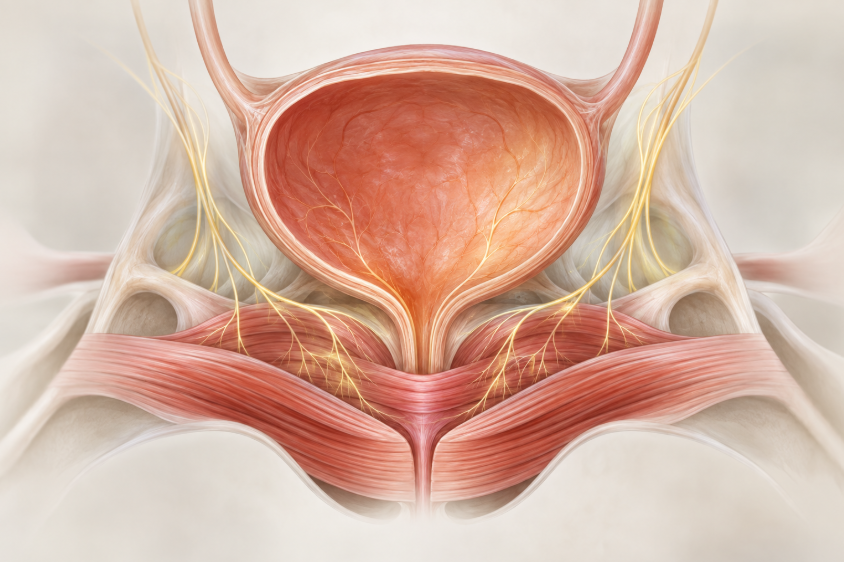
The bladder and pelvic floor are closely connected through shared neural pathways, allowing each to influence the other.
As the bladder fills, the nervous system receives information about what is happening. When it is appropriate to urinate, the bladder and pelvic floor need to coordinate their activity so urine can be released.
So even under ordinary circumstances, the bladder and pelvic floor are not independent systems. They are continually communicating and responding to information from the nervous system.
They Also Share Neural Pathways
This is one of the pieces I find especially fascinating.
The pelvic organs and pelvic floor muscles share many of the same neural pathways. Signals coming from the bladder and signals coming from the muscles don’t necessarily remain completely separate as they travel through and are processed by the nervous system.
Why does that matter?
Because what is happening in one part of the system can influence another.
When the bladder is irritated, painful, or repeatedly sending strong sensory information, the nervous system may respond with increased protective activity in the muscles surrounding that area.
The pelvic floor may tighten or guard.
Initially, that can be a perfectly understandable protective response.
But if that muscular activity persists, the pelvic floor itself can become another source of pain, pressure, tension, and sensory input.
Now we have the potential for a two-way conversation.
IC and an Overactive Pelvic Floor Can Coexist
Having an IC/BPS diagnosis does not mean every symptom must be attributed exclusively to the bladder.
Likewise, finding an overactive pelvic floor does not mean the bladder isn’t involved.
Both can be true.
Bladder irritation or pain may contribute to pelvic floor guarding. Over time, those muscles may have difficulty fully letting go.
An overactive pelvic floor can then contribute to symptoms such as:
- Pelvic or bladder-area pain
- Pressure or heaviness
- Urinary urgency
- Urinary frequency
- Difficulty starting or fully emptying
- Pain associated with urination
- Pain with sexual activity
- Symptoms that increase with certain activities, positions, or loads
And because many of these symptoms overlap with those associated with IC/BPS, it isn’t always possible to determine where a symptom originates simply by where you feel it.
Pain Location Doesn’t Always Tell Us the Whole Story
This is an important concept in persistent pelvic pain.
If you feel pain in the area of your bladder, the experience is real—but the location of the pain does not necessarily tell us everything about what is contributing to it.
The bladder may be contributing.
The pelvic floor may be contributing.
The nervous system may be responding to information from both.
Other factors—including movement, breathing, abdominal and pelvic pressure, sleep, stress, hormonal changes, bowel function, and previous experiences with pain—may also influence how the system responds on a particular day.
This doesn’t make the symptoms less physical.
It means the body is more interconnected than a single-structure explanation allows.
Why Activity Can Sometimes Bring Symptoms to the Surface
Some people notice their bladder or pelvic symptoms increase with activities such as running, jumping, lifting, prolonged sitting, or certain forms of exercise.
That doesn’t automatically mean the activity is harmful or that it needs to be permanently avoided.
It may tell us something about what the system can comfortably manage right now.
Movement changes the demands placed on the pelvic floor. Impact, breathing, trunk activity, load, and changes in intra-abdominal pressure all require the pelvic floor to respond and adapt.
If the pelvic floor is already working harder than it needs to—or having difficulty returning to a more relaxed state—additional demand may contribute to an increase in symptoms.
Rather than simply labeling an activity as “good” or “bad,” we can become curious about what the response is telling us.
An Overactive Pelvic Floor Isn’t Necessarily a Weak Pelvic Floor
This is also why automatically strengthening the pelvic floor isn’t always the answer.
A muscle can be active much of the time and still not function well.
A pelvic floor that has difficulty letting go may first need support with relaxation, lengthening, coordination, breathing, movement, and nervous-system regulation before additional strengthening is appropriate.
The goal isn’t simply to make the pelvic floor stronger.
The goal is to help it respond appropriately—to contract when contraction is needed, release when release is needed, and adapt to the demands of everyday life.
Looking Beyond the Bladder Doesn’t Mean Ignoring the Bladder
This distinction matters.
Looking at the pelvic floor or nervous system does not mean saying:
“Your bladder is fine.”
“It’s just tight muscles.”
Or, perhaps worst of all, “It’s all in your head.”
It means recognizing that persistent symptoms can involve multiple systems at the same time.
For someone living with IC/BPS, a more complete assessment may include the bladder and urinary system while also considering pelvic floor function, the nervous system, breathing, movement, pressure management, bowel function, and other factors that may be influencing symptoms.
Different people will have different contributors. There isn’t one universal explanation for IC/BPS, and there isn’t one universal solution.
Sometimes a Wider Lens Gives Us More Options
When symptoms have been present for a long time, it can be frustrating to keep focusing on the painful area without making the progress you hoped for.
Widening the lens doesn’t dismiss the bladder.
It gives us more information.
The bladder can influence the pelvic floor. The pelvic floor can influence the experience of bladder symptoms. And the nervous system is continually receiving, interpreting, and responding to information from both.
Understanding that relationship can help us move away from asking only:
“What is wrong with my bladder?”
and begin asking:
“What is influencing my symptoms, and what does my system need right now?”
Sometimes that change in perspective opens the door to possibilities we couldn’t see when we were looking at the bladder alone.